Brief Introduction
Examining how the information environment shapes economic decision making through spillover effects matters because decisions rarely occur in isolation.
Time and Venue
Date: April 27, 2026 (Monday)
Venue: E22-G013
Organizing Committee
Prof. Jason Zezhong XIAO, Prof. Morris Ming LIU, Prof. Rubin HAO, Prof. Duncan Jiancheng LIU & Prof. Yingzhen JIANG
Workshop Agenda
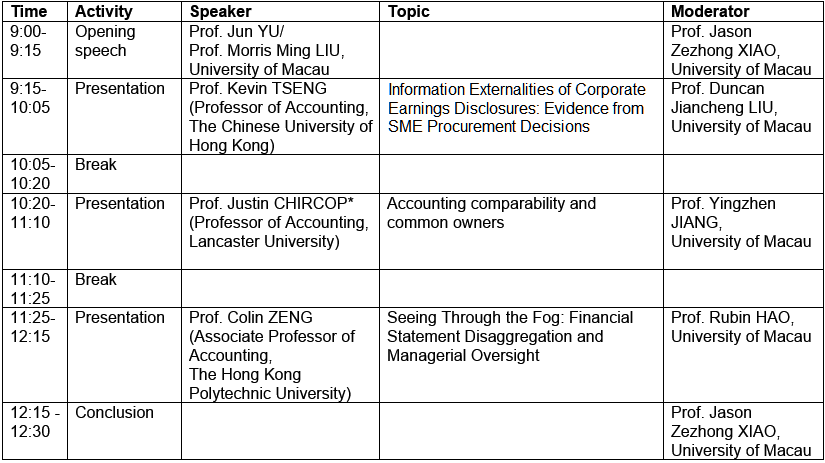
*UM Distinguished Visiting Scholar of UM Talent Programme
Speakers and Talks Information
Prof. Kevin TSENG

Kevin Tseng is a Professor at the Chinese University of Hong Kong (CUHK) Business School and Director of the newly established Faculty Development Centre. Professor Tseng’s research explores how access to innovation and information interact to shape economic behavior and market dynamics. His research spans knowledge spillovers, asset pricing, disclosure, innovation economics, behavioral economics, corporate finance, and household finance. His articles have appeared in leading scholarly journals, including The Journal of Finance, the Journal of Accounting and Economics, Review of Financial Studies, The Accounting Review, Management Science, the Journal of Financial and Quantitative Analysis, and Contemporary Accounting Research. He currently serves as Editor of the Journal of Contemporary Accounting & Economics, Associate Editor of Accounting and Business Research and the Asia-Pacific Journal of Accounting & Economics, and a member of the Executive Board of the Asian Innovation and Entrepreneurship Association (AIEA).
Topic: Information Externalities of Corporate Earnings Disclosures: Evidence from SME Procurement Decisions
We examine whether and how small and medium-sized enterprises (SMEs) adjust their operational decisions in response to the earnings information disclosed by nearby public firms. Using highly granular transaction-level data from value-added tax (VAT) invoices issued by Chinese SMEs, we conduct a short-window event study around mandatory corporate earnings-forecast disclosure. We find that SMEs significantly increase procurement following positive earnings surprises, consistent with earnings news serving as a forward-looking demand signal. The effect is strongest when the news receives greater media or analyst attention, when SMEs operate in the same industry as the disclosing firm, and when SMEs are newly established, employ financial specialists or have younger CEOs—settings that enhance information acquisition and processing. Furthermore, the observed adjustments in SMEs procurement are concentrated in production-related core materials, underscoring the operational relevance of earnings signals. We also find that SMEs’ procurement adjustments translate into subsequent sales growth, but that they fail to identify opportunistic earnings boosting, reacting even to inflated forecasts. Our evidence suggests that public firm disclosures generate economically meaningful information externalities that shape real decisions beyond capital markets, extending the scope of financial reporting’s real effects to the millions of private firms that underpin local economies.
Prof. Justin CHIRCOP

Professor Justin Chircop is an accomplished academic in Accounting and Finance at Lancaster University Management School, where he currently serves as Professor of Accounting. He holds a PhD in Accounting and Finance from Lancaster University, an MSc in Accounting and Finance from the University of Aberdeen, and a Bachelor of Accountancy (Hons) from the University of Malta.
Professor Chircop’s research spans financial reporting, accounting comparability, corporate governance, and the economic consequences of regulation, with publications in leading journals such as The Accounting Review, Journal of Accounting Research, Journal of Accounting and Economics, and Journal of Corporate Finance. His work has received awards at international conferences and featured in media outlets like Bloomberg Opinion, ICAEW Insights, and Columbia Law School’s CLS Blue Sky Blog.
He has held visiting positions at the University of Padua, the University of Iowa, and UNC Chapel Hill as a Fulbright Scholar. He also serves as Associate Editor for the British Accounting Review and sits on the editorial board of Accounting Forum.
Beyond research, he has developed innovative teaching modules on financial data platforms and supervised multiple PhD students. He is a Fellow of the ACCA and the UK Higher Education Academy and actively contributes as a reviewer for top-tier journals and grant bodies.
Topic: Accounting comparability and common owners
Abstract: We examine the relationship between accounting comparability and common ownership. Accounting comparability can reduce information asymmetry between firms and investors by lowering information acquisition and processing costs. At the same time, greater comparability may reduce the private information advantages that sophisticated investors, such as common owners, can exploit. Which of these opposing forces dominates is ultimately an empirical question.
Using a sample of U.S. firms for 1999-2021, we find that accounting comparability is positively associated with common ownership, particularly non-transient common ownership. Further analyses indicate that this relation is driven by a reduction in information asymmetry and is significantly stronger among firms with weaker information environments.
Prof. Colin ZENG

Cheng (Colin) Zeng is an Associate Professor of Accounting at The Hong Kong Polytechnic University. Prior to joining PolyU, he held academic positions as an Assistant Professor at the University of Bristol and as an Associate Professor at the University of Manchester. His research interests are broad, encompassing accounting, finance, and economics. Specific areas of focus include the influence of political and regulatory factors on financial reporting, International Financial Reporting Standards (IFRS), and China-related topics.
His work has been published in leading academic journals such as the Journal of Accounting Research, The Accounting Review, Management Science, Contemporary Accounting Research, Accounting, Organizations and Society, and Production and Operations Management, among others. In addition to his research, Colin serves as an Associate Editor for Abacus and the British Accounting Review.
Topic: Seeing Through the Fog: Financial Statement Disaggregation and Managerial Oversight
Abstract: The role of financial information disaggregation in contracting is important but remains underexplored. Leveraging a regulatory change in China that requires firms to disclose R&D expenses as a separate line item in their income statement rather than aggregating them under administrative expenses, we examine whether such disaggregation enhances external monitoring of managerial behavior. Using a difference-in-differences design, we find that firms that are more affected by the disclosure rule experience a significantly larger decline in both abnormal executive compensation and perks embedded within administrative expenses. The effect is more pronounced in firms with stronger external monitoring of administrative expenses, less sophisticated investors, excessive pre-reform administrative expenses, and in non-state-owned enterprises. We also find that abnormal administrative expenses are priced more negatively and that administrative expenses become less sticky following the reform. Overall, our findings offer new insights into the role of disaggregated financial information in strengthening corporate governance and improving resource allocation efficiency.