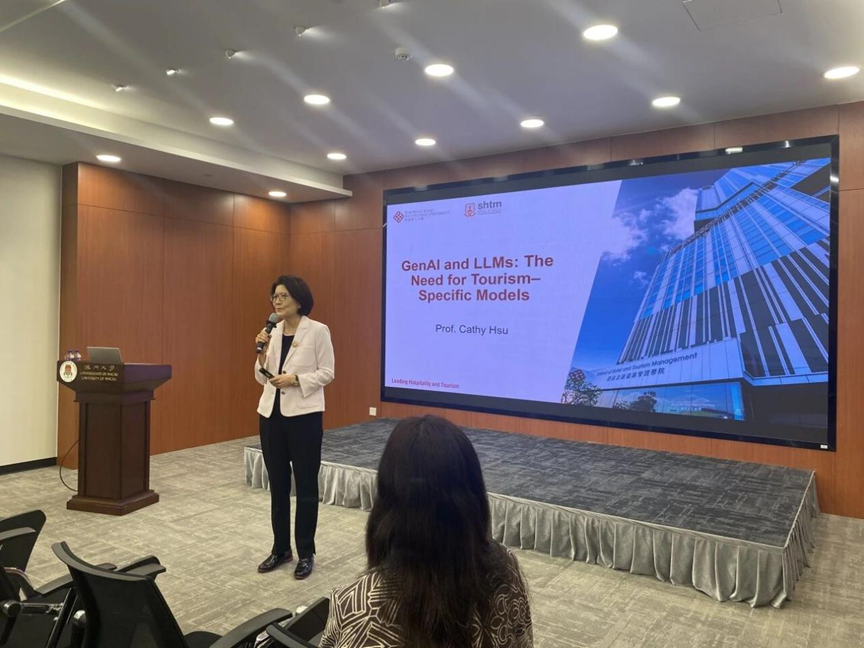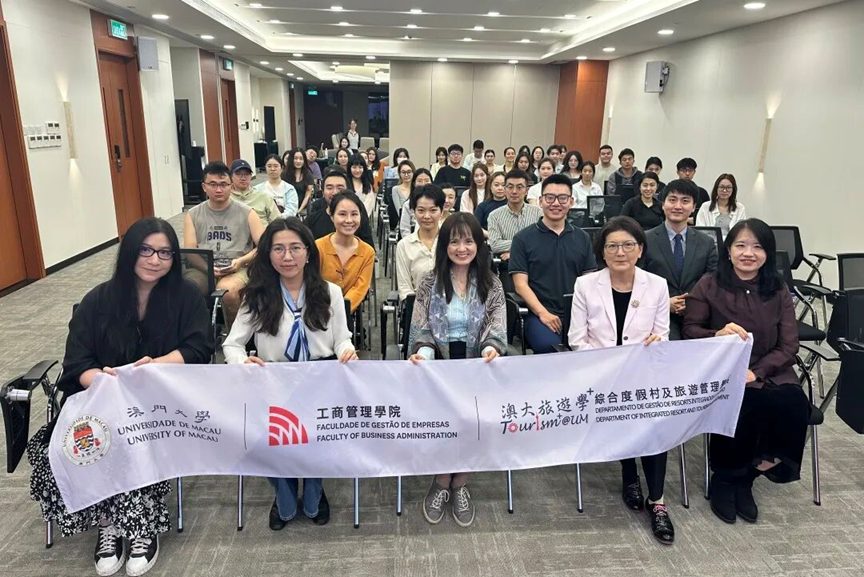
On 30 March 2026, the Department of Integrated Resort and Tourism Management, Faculty of Business Administration, University of Macau held an academic seminar featuring Prof. Cathy Hsu, Chair Professor of the School of Hotel and Tourism Management at The Hong Kong Polytechnic University. The seminar was titled “Generative AI and Large Language Models – The Need for Tourism-Specific Models”. It delved into the limitations of general-purpose AI models in tourism research and demonstrated the advantages of fine-tuning domain-specific models with tourism knowledge. The seminar was moderated by Assistant Prof. Hyunsu Kim.
Opening: Concerns and a Critical Perspective on AI Models
Prof. Hsu began by highlighting common issues with current generative AI and large language models, encouraging the audience to adopt a critical mindset when evaluating subsequent research cases. She listed several notable concerns: lack of transparency in information sources; training data predominantly from the Western world, leading to a “Western worldview” bias; potential semantic shifts due to translation across different cultural contexts; lack of domain-specific knowledge and contextual awareness; high costs of data updates; susceptibility to misinformation, misinterpretation, and hallucinations; and systematic bias in training data that may lead to stereotypes and discrimination.
She shared a small experiment: when repeatedly asking an AI “Is a certain hotel in Hong Kong safe?” the AI initially answered “safe”, but after multiple queries, the answer subtly changed to “safe, but some people may still have concerns.” This reveals the inherent instability and generative nature of AI.
Four Empirical Research Projects: Enhancing Model Performance with Tourism Domain Knowledge
To demonstrate the effectiveness of tourism-specific models, Prof. Hsu’s team conducted a series of studies, including both published and ongoing projects:
(1) Calculating Tourist Sentiment Ambivalence (published in Tourism Management)
The study found that tourists may experience both positive and negative emotions toward different aspects of a destination simultaneously – for example, liking certain aspects (scenery, facilities, transport, commercial atmosphere) while disliking others (dining, service, price). This phenomenon is termed “sentiment ambivalence.” Drawing on schema theory, the team integrated tourism domain knowledge into the BERT model, proposing TK-BERT, and analysed multi-platform online reviews of a Hong Kong attraction. Results showed that TK-BERT significantly outperformed the original BERT and other state-of-the-art models in calculating sentiment ambivalence.
(2) Continuous Tourist Sentiment Scoring (published in Tourism Review)
This study proposed a novel framework based on RoBERTa-CSS, enabling near-continuous scoring of tourist sentiment and capturing longitudinal and group-level emotional dynamics, thereby providing real-time monitoring tools for destination management.
(3) Decoding Tourist-Resident Emotion Dynamics in Reciprocal Tourism (ongoing)
In the context of reciprocal tourism between Hong Kong and Mainland China, where residents and tourists frequently reverse roles, complex emotions arise. The team fine-tuned the DeepSeek model, proposing DeepSeek-EMO, to identify emotions between the two groups. Its performance surpassed other mainstream models.
(4) Destination Performance Evaluation Framework (ongoing)
This study aims to establish a dynamic destination performance evaluation framework that systematically leverages user-generated online reviews. The team benchmarked eight large language models against human annotations to select the best-performing model for fine-tuning, then integrated it into the framework. Results indicated that large-parameter models (e.g., Gemma3 27B, DeepSeek-R1 70B) generally outperformed smaller-parameter models in attribute extraction and sentiment classification, confirming the positive relationship between model scale and performance.
Key Takeaways: Domain Knowledge and Rigorous Methodology
Prof. Hsu summarised several important takeaways: domain knowledge is crucial, requiring human annotation to review the appropriateness of keywords and output clusters; human annotation is indispensable for model training, especially given the prevalence of slang, puns, and sarcasm in social media language; models fine-tuned on industry-specific data perform better; research should maintain rigorous methodology and transparency; and interdisciplinary collaboration across tourism, computer science, ethics, and other fields is encouraged.
Q&A Session: Challenges and Boundaries
During the Q&A session, faculty and students actively raised questions about practical challenges in developing tourism-specific models. Regarding hardware and computing resources, Prof. Hsu acknowledged the need for certain computing skills, time investment, and adequate computational equipment. When asked about the boundary between “AI aversion” and “AI appreciation”, she noted that it is closely related to users’ age and past experience, with different groups showing varying levels of acceptance. On how to obtain data from platforms such as Xiaohongshu (Red) and Douyin (TikTok), she responded that some data can be purchased, and advised researchers to establish partnerships with data suppliers.
Conclusion
The seminar offered both a profound critique of general-purpose AI models and empirically grounded tourism-specific solutions, demonstrating how domain knowledge and interdisciplinary perspectives can promote the responsible application of generative AI in tourism research. It sparked lively discussion and deep reflection among the attending faculty and students.