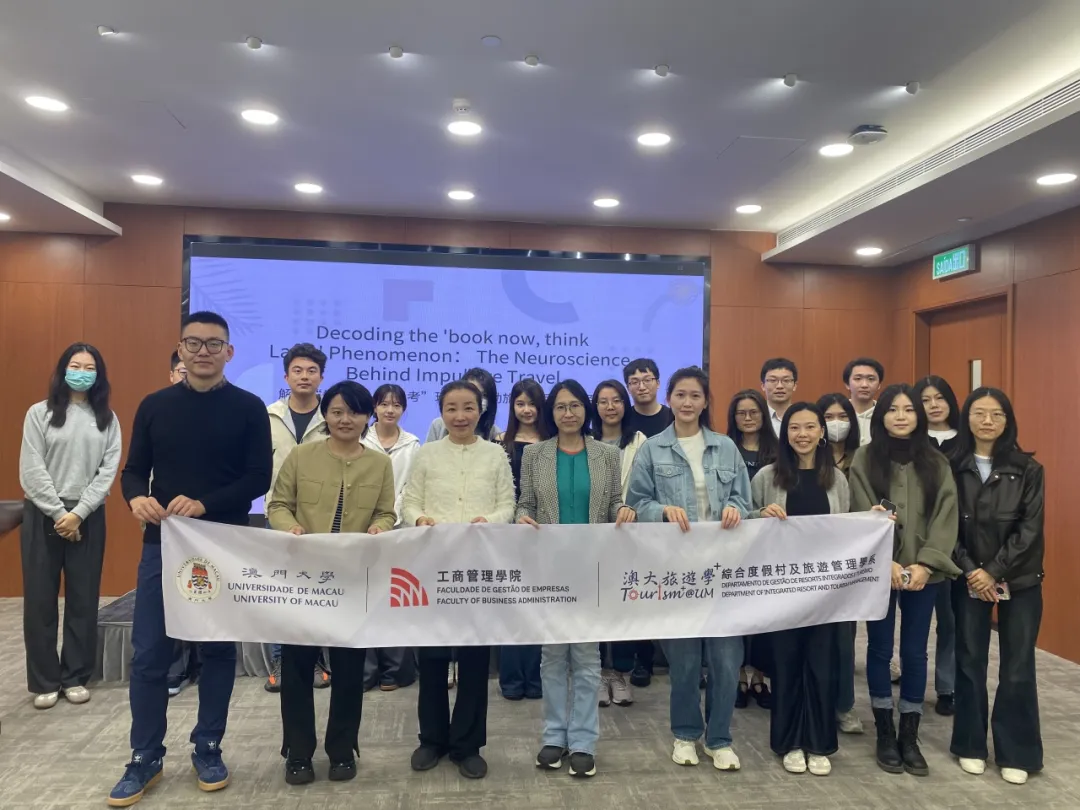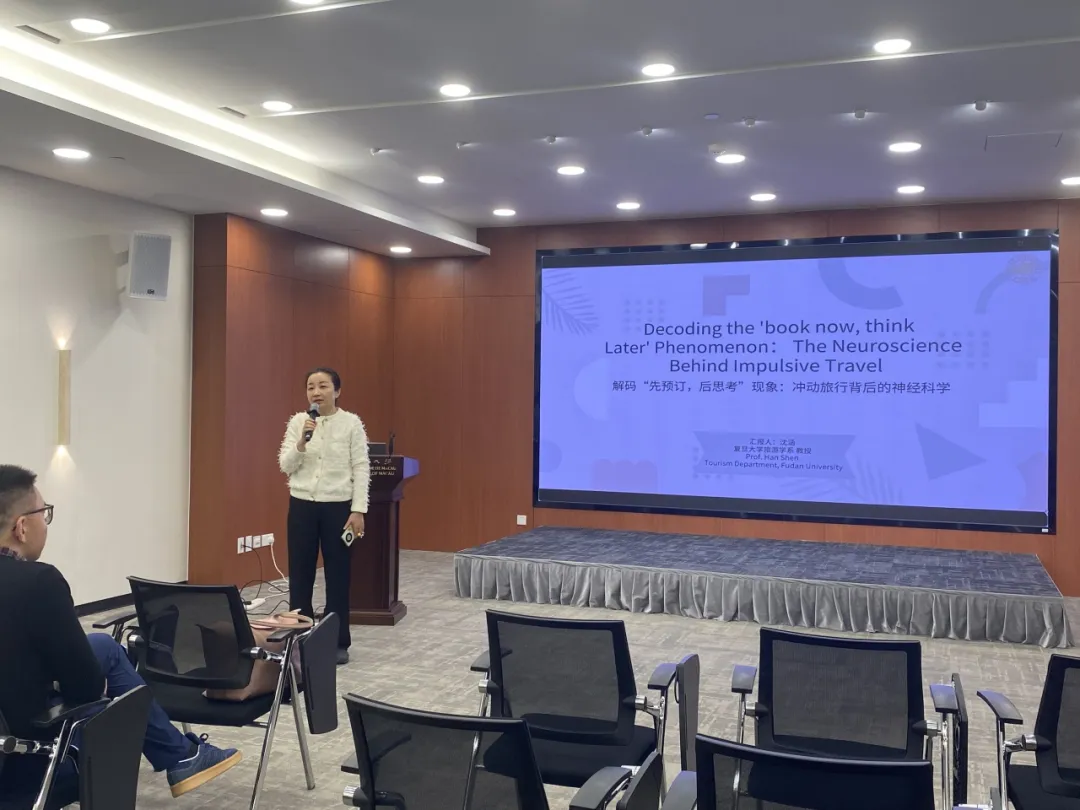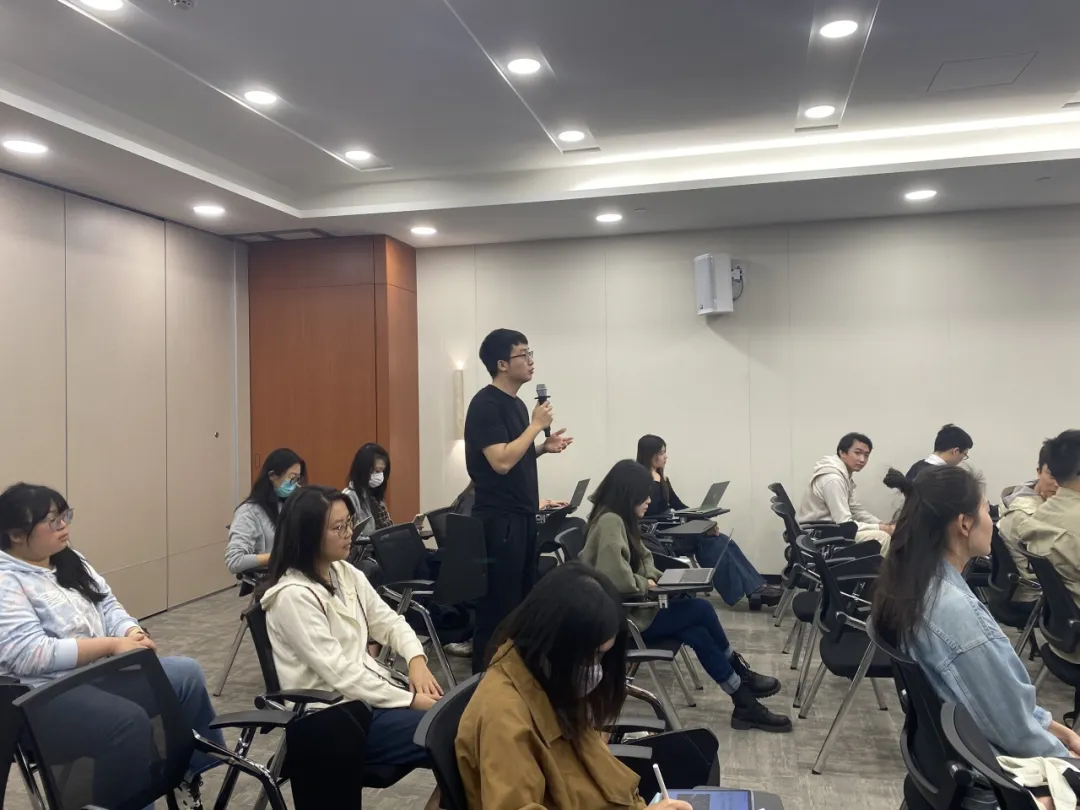
Recently, the Department of Integrated Resort and Tourism Management successfully hosted an academic lecture. Professor Han Shen from the Fudan University was invited to deliver a presentation titled “Decoding the ‘Book Now, Think Later’ Phenomenon: The Neuroscience Behind Impulsive Travel,” which provided an in-depth analysis of the increasingly common phenomenon of “book first, think later” tourism in the digital era.
Professor Shen began by highlighting a striking contradiction in today’s tourism market: up to 89% of travel decisions are emotionally driven impulsive behaviors, yet traditional tourism decision-making theories fail to effectively explain this phenomenon. She analyzed the limitations of two mainstream theories: the rational choice theory assumes consumers calmly weigh all information, which clearly contradicts the reality of “impromptu trips”; while the linear funnel model is too static and idealized to capture the instantaneous desire arousal and internal conflict processes in impulsive decision-making. It is precisely this disconnect between theory and reality that calls for the emergence of a new explanatory framework.
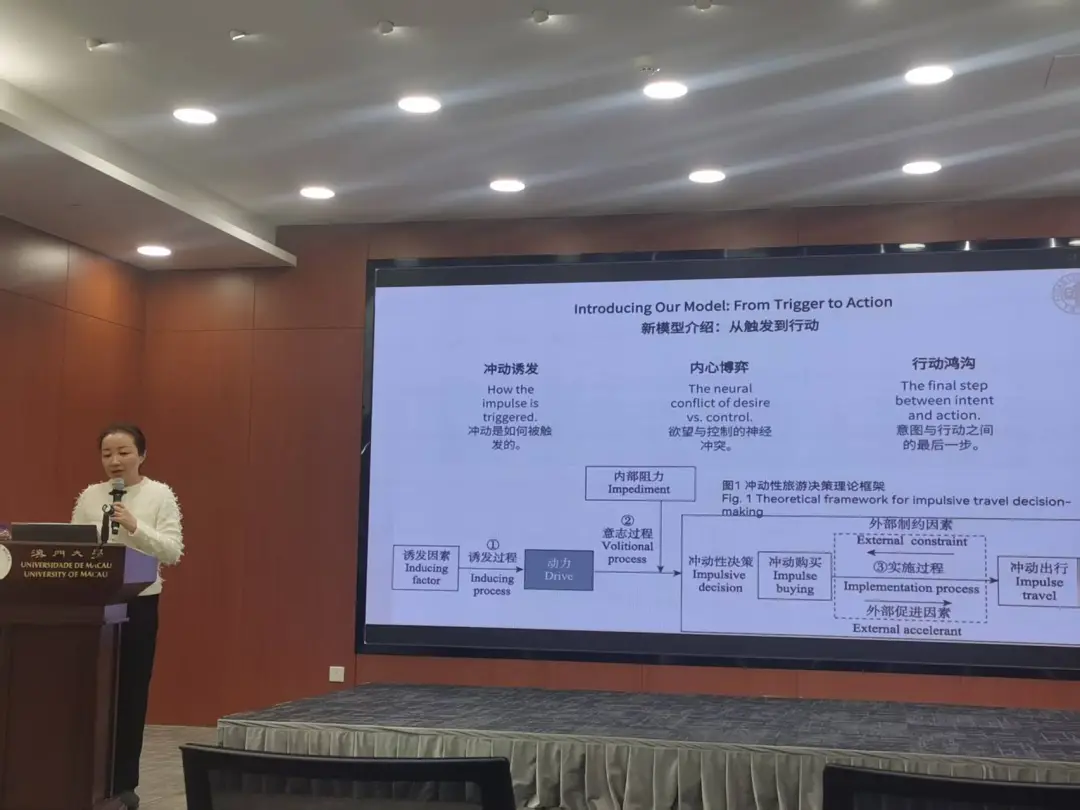
To address this, Professor Shen and her team proposed a novel “Impulsive Tourism Decision-Making Framework.” This model deconstructs seemingly spur-of-the-moment behavior into a dynamic process consisting of three core stages:
First, impulse arousal stems from the instantaneous collision between external stimuli (such as stunning images on social media or limited-time offers) and internal psychological needs (such as the desire for novelty or escape from reality), igniting an immediate urge to act. This is followed by a critical internal deliberation stage, where the brain’s limbic system, responsible for immediate emotions, engages in intense conflict with the prefrontal cortex, which handles long-term planning. Consumers experience cognitive friction and emotional cooling between “wanting” and “whether they should.” Finally, with the combined effect of internal motivation and external facilitating conditions (such as one-click booking), decision-makers bridge the final action gap, transforming impulse into actual purchasing behavior.
To empirically validate this theoretical model, Professor Shen and her team introduced several cutting-edge cognitive science research methods. Among these, eye-tracking experiments provided direct evidence: data showed that when browsing tourism advertisements, consumers spent 2.3 times longer focusing on emotionally compelling large images than on practical text such as prices or itineraries. This empirically established the “visual-first” principle, confirming that decisions are indeed initiated by emotional resonance. Additionally, technologies such as electroencephalogram (EEG) monitoring helped directly observe the dynamic neural-level interplay between desire and rationality.
Based on these scientific findings, Professor Shen distilled clear managerial insights for the industry: the key to success lies in effectively reducing consumers’ decision hesitation time and minimizing cognitive friction. Specifically, marketers should maximize the emotional impact of visual content to quickly “capture” attention, simplify the booking process to reduce barriers to action, and strategically employ nudging signals such as “limited-time offers” or “limited availability” at critical moments to help consumers smoothly transition from desire to action.
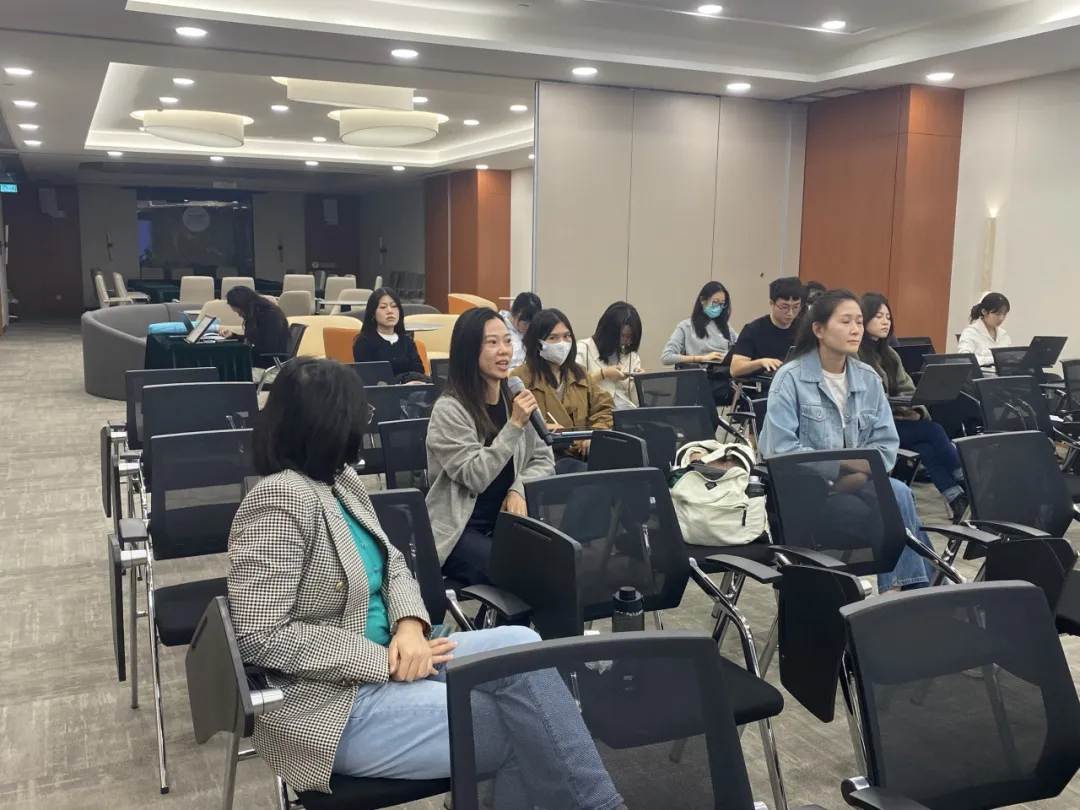
This lecture integrated perspectives from neuroscience, psychology, and management, not only offering a profound decoding of the scientific logic behind impulsive travel but also providing the industry with a comprehensive approach from “insight” to “nudge.” It sparked extensive reflection and lively discussion among the faculty and students present.