Prof. Bob McKercher from the School of Hotel and Tourism Management at The Hong Kong Polytechnic University visited the Department of Integrated Resort and Tourism Management at the University of Macau on March 5 to deliver two lectures:“The Challenge Facing Sustainable Tourism: Can Ecotourism Provide a Path Forward?” and “Tourism Research: 50 Years of Tourism, Hospitality and Events Journals Published in English.”The seminars were hosted by Prof. Anthony Wong and attracted a large audience of faculty and students.
Session 1: The Challenge Facing Sustainable Tourism: Can Ecotourism Provide a Path Forward
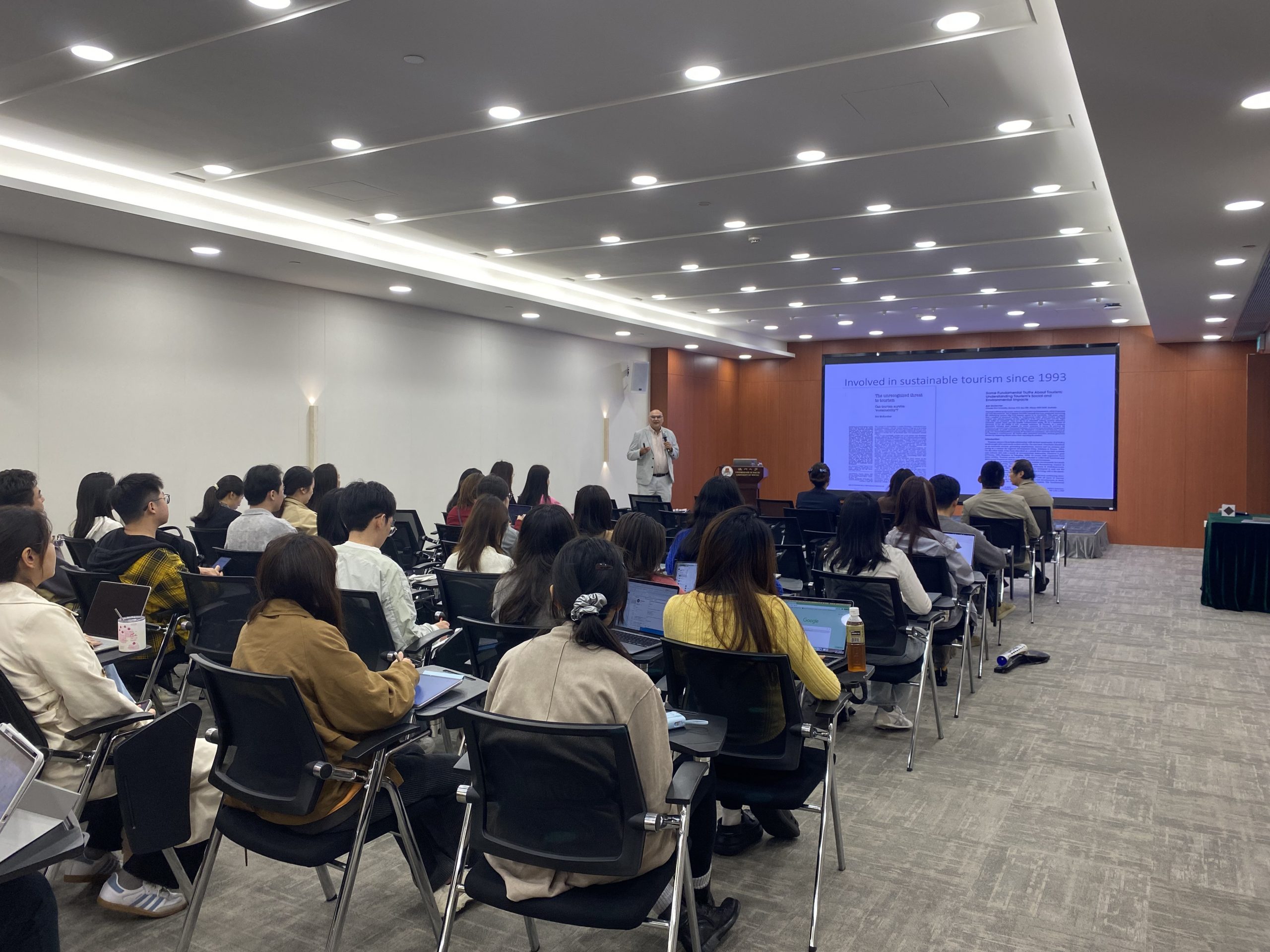
Prof. McKercher opened by stating that the global economy is inherently unsustainable, calling “net-zero by 2050 a myth.” As part of the global economy, the tourism industry cannot achieve sustainability on its own. Currently, tourism accounts for approximately 8% of global carbon emissions, and this figure is expected to continue rising. Using the aviation sector as an example, he noted that there are currently over 100,000 commercial flights per day, a number projected to reach 200,000 by the 2030s. Crucially, aviation is not covered by the Paris Accord, adding further complexity to the pursuit of sustainable tourism. Although some had hoped that the pandemic would catalyze a transformation in tourism, international arrivals in 2024 returned to pre-pandemic levels, indicating that structural changes have yet to materialize.
Reflecting on the evolution of ecotourism, Prof. McKercher observed that it was once seen as a “world-changing” solution—one that would shift consumer attitudes, revitalize rural areas, and demonstrate that “small is beautiful.” Today, the academic understanding of ecotourism has become more nuanced, encompassing both cultural and natural landscapes, and giving rise to diverse forms such as urban ecotourism, soft ecotourism, and hard ecotourism. He highlighted the emergence of “mass ecotourism”in Asia, which relies on traditional mass tourism infrastructure and treats ecotourism as a day-trip add-on. In the Chinese market, attitudes toward nature are deeply rooted in 5,000 years of cultural tradition, making Western models potentially unsuitable.
Prof. McKercher concluded with a fundamental question: “Can tourism ever be sustainable?” In his view, ecotourism is not the final destination but a step forward—the key lies in minimizing impacts, rather than focusing solely on scale.
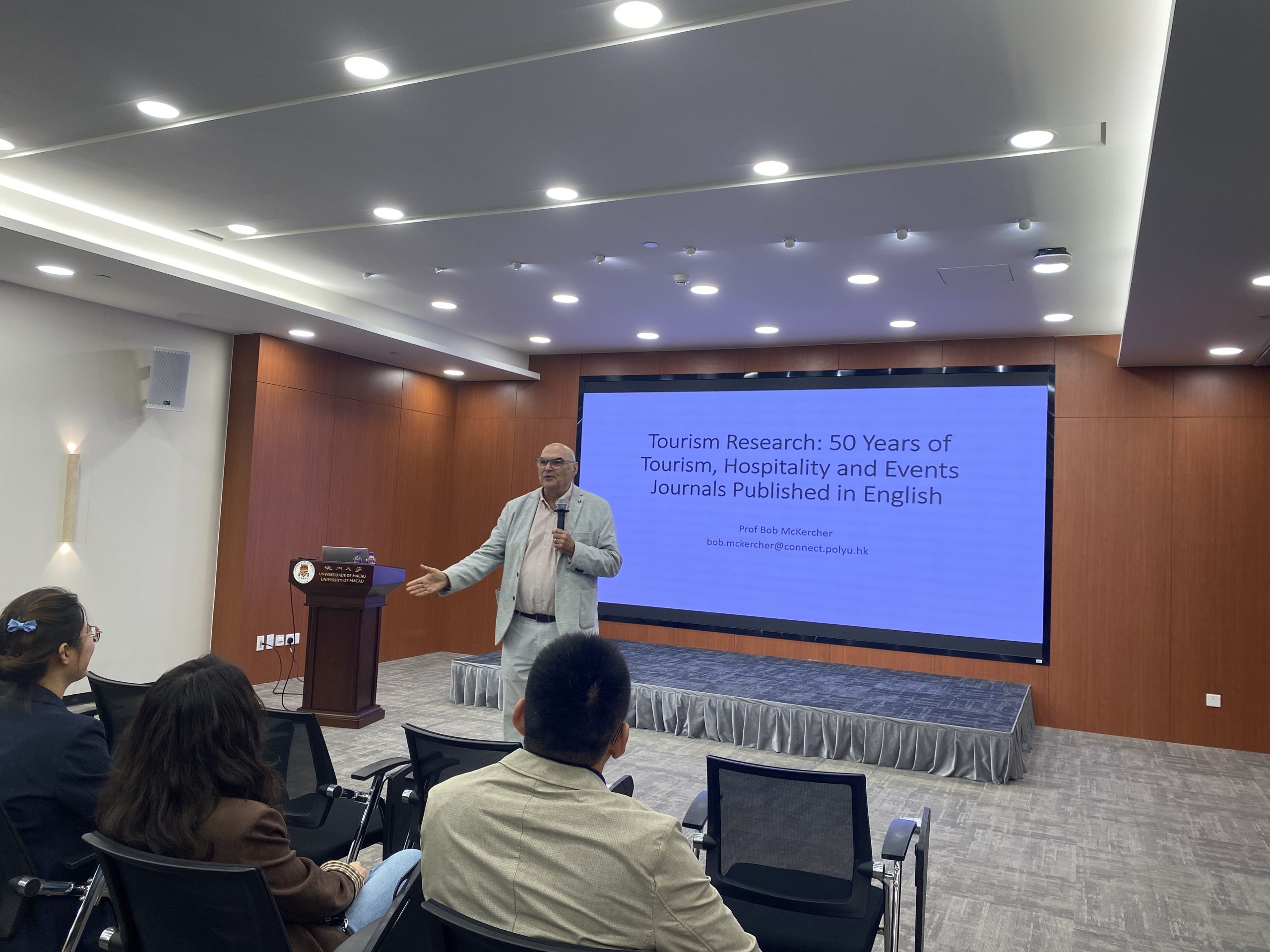
Session 2: Tourism Research: 50 Years of Tourism, Hospitality and Events Journals Published in English
Drawing on SCOPUS data from 1975 to 2024, Prof. McKercher analyzed trends across more than 62,000 papers and 60,550 authors. The journal landscape has grown exponentially: in the late 1970s, only a few dozen papers were published annually; in the past five years, that number exceeded 23,800. The number of authors has grown from fewer than 230 to over 35,300, yet more than 40,000 authors have published only once, reflecting a high rate of “one-time participation.”
In terms of co-authorship, single-authored papers are increasingly rare, with cross-institutional and international collaboration becoming the norm. However, Prof. McKercher noted that some of this growth can be attributed to questionable practices such as author stacking, “slicing” research into multiple papers, and the inclusion of honorary or gift authors.
He offered a cautionary note for early-career scholars. The pressures of contemporary academia often expect PhD graduates to emerge as “fully formed scholars,” leading many to pursue short-term goals at the expense of long-term development. He posed a critical question: what better defines an academic career—one paper in a top-tier journal, or many papers in mid- and lower-tier journals? He advised scholars to choose collaborators carefully, clearly define their own contributions, and avoid becoming followers in “paper mills.” He also warned against “framework bias,” noting that research frameworks can sometimes reveal more about their own limitations than about the phenomenon under study.
Prof. McKercher ended with a thought-provoking question: “How do you want to be remembered?” As someone who publishes numerous easily forgettable papers, ultimately leading to a forgettable career? Or as someone who engages in lifelong learning, persistently asks “why” rather than just “what,” and makes a meaningful difference—achieving a satisfying and lasting academic journey? “The choice is yours,” he said.
Closing Remarks
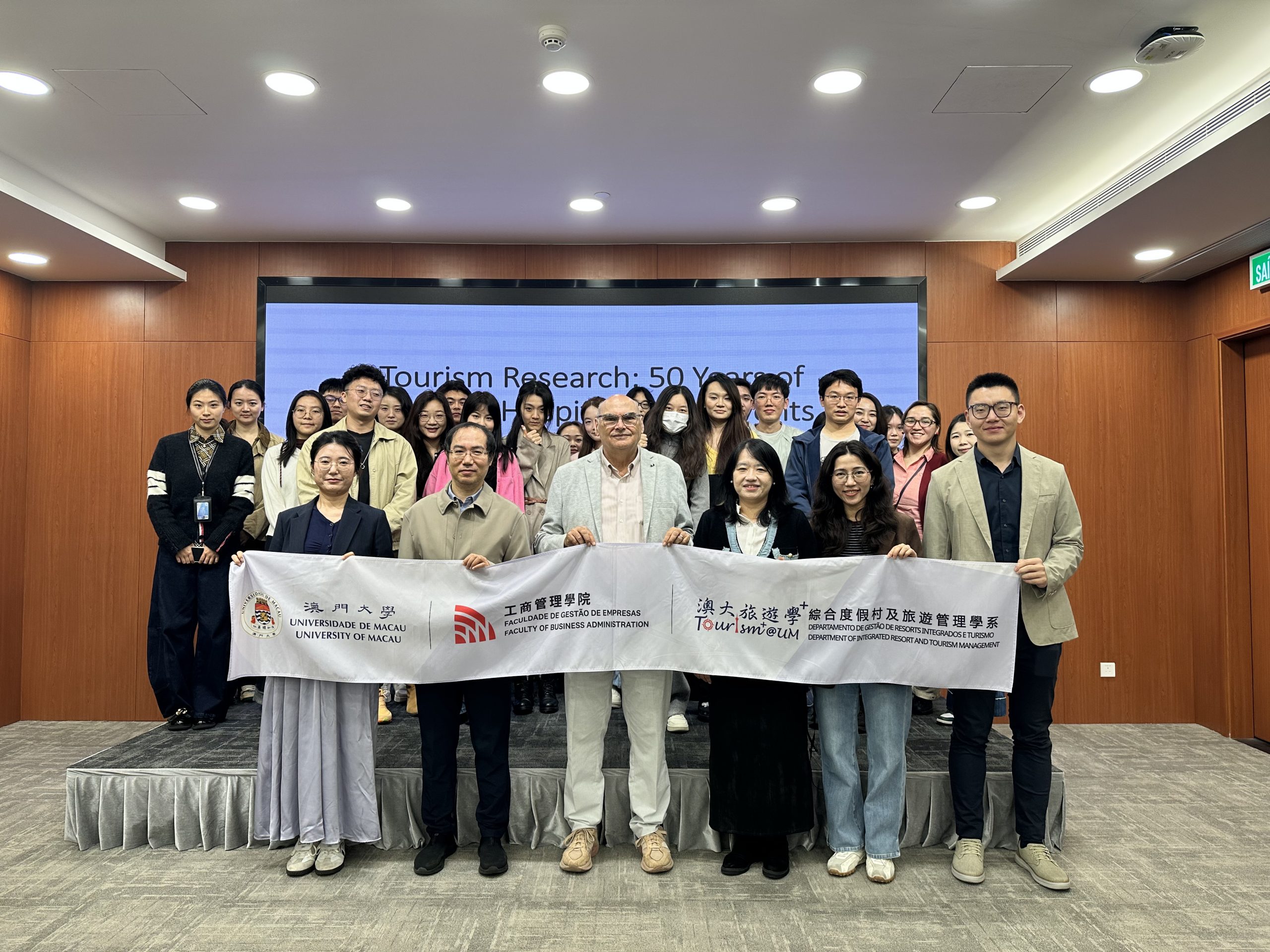
With five decades of academic insight, Prof. Bob McKercher delivered two lectures that combined critical perspective with deep humanistic concern. From the macro-level challenge of global carbon emissions to the micro-level ethics of journal publishing, his presentations prompted profound reflection on the nature of scholarship and the future of tourism. Following the seminars, Prof. Anthony Wong presented a token of appreciation to Prof. McKercher on behalf of the department, and all participants joined together for a group photo.