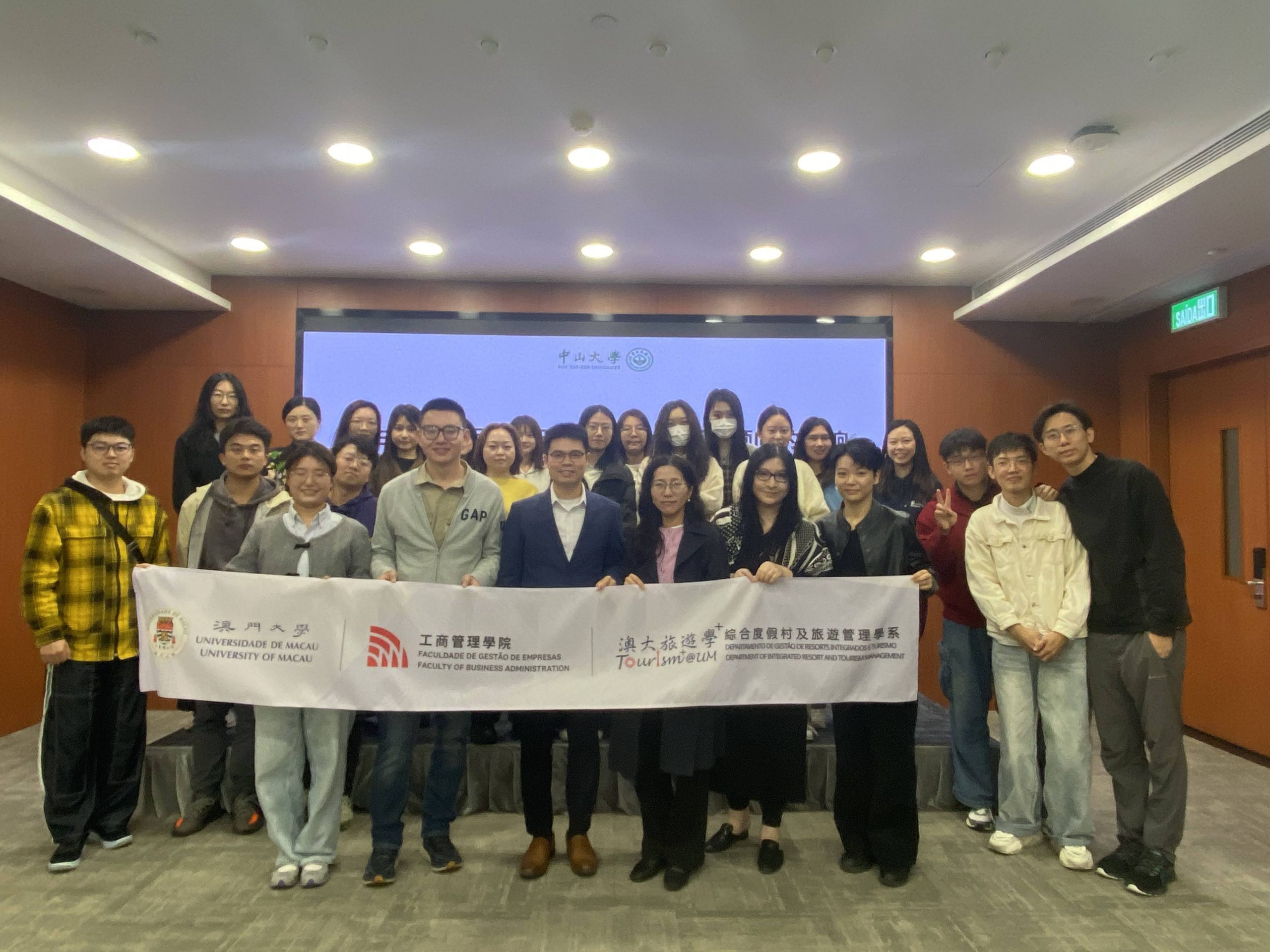
On November 20, 2025, Professor Yaoqi Li from the School of Tourism Management at Sun Yat-sen University was invited to the Integrated Resort and Tourism Management Department of the University of Macau, where he delivered a captivating lecture titled “Seize the Day and Enjoy Every Moment: The Influence of Temporal Perspective on Individual Consumption Decisions,” skillfully blending literary imagery with scientific evidence. The lecture was hosted by Assistant Professor Biqiang Liu of the department.
Professor Li opened his talk with the famous line from Li Bai’s poem “Bring in the Wine”—”When life is good, one must enjoy it to the fullest”—vividly introducing the core concern of his research: how different perceptions of the passage of time profoundly influence individuals’ consumption decisions and lifestyles. He pointed out that, within the broader context of stimulating consumption and expanding domestic demand, implicit nudging at the psychological level may yield more lasting effects compared to material incentives such as consumption vouchers.
Building on this, Professor Li systematically explained the theoretical foundation of his research—two temporal perspectives: the linear time perspective and the cyclic time perspective. Drawing on insights from physics and philosophy, he defined the “linear perspective” as viewing time as an irreversible, one-way flow, emphasizing the irreversibility and uniqueness of life. In contrast, the cyclic perspective regards time as a recurring cycle, highlighting repetition and recurrence. These deeply ingrained cognitive frameworks subtly shape whether individuals opt for “seizing the moment” experiential consumption or lean toward delayed gratification and repetitive consumption.
By integrating multiple methodologies, including secondary data analysis, experiments, large-scale surveys, and field experiments, Professor Li’s team validated the core finding: individuals with a linear time perspective exhibit significantly higher consumption tendencies than those with a cyclic time perspective. The underlying mechanism lies in the fact that a linear perspective more easily stimulates demand for experiential consumption—specifically, the desire to acquire unique, once-in-a-lifetime experiences. The research further revealed a key boundary condition: the framing of time effectively moderates this relationship. When information is presented within a scarcity-driven framework—such as limited time or rare opportunity—the promoting effect of a linear time perspective on consumption is significantly enhanced. Conversely, an open-ended framework weakens this effect.
Professor Li concluded by emphasizing that this study not only introduces the theoretical lens of temporal psychology into the field of consumption promotion, expanding the research boundaries of framing effects, but also provides novel insights for policy design and business practices. By skillfully guiding public perceptions of time, consumption potential can be unleashed in a gentler, more sustainable manner, thereby contributing to sustained domestic demand growth.
The lecture presented profound concepts in an accessible manner, supported by robust empirical evidence. During the Q&A session, faculty and students engaged in a lively and thoughtful discussion with Professor Li on topics such as the distinction between time perspective and temporal distance, creating a vibrant atmosphere of intellectual exchange.