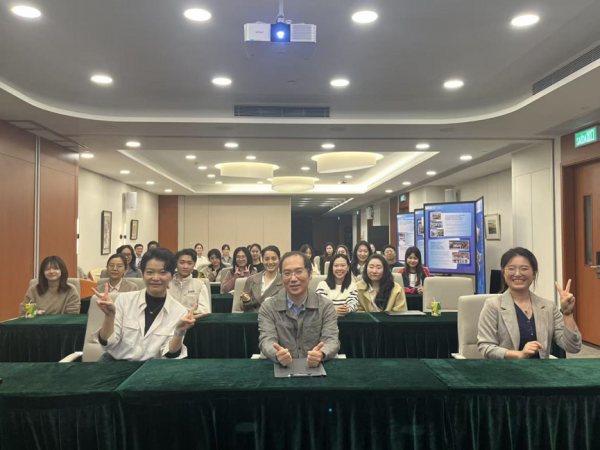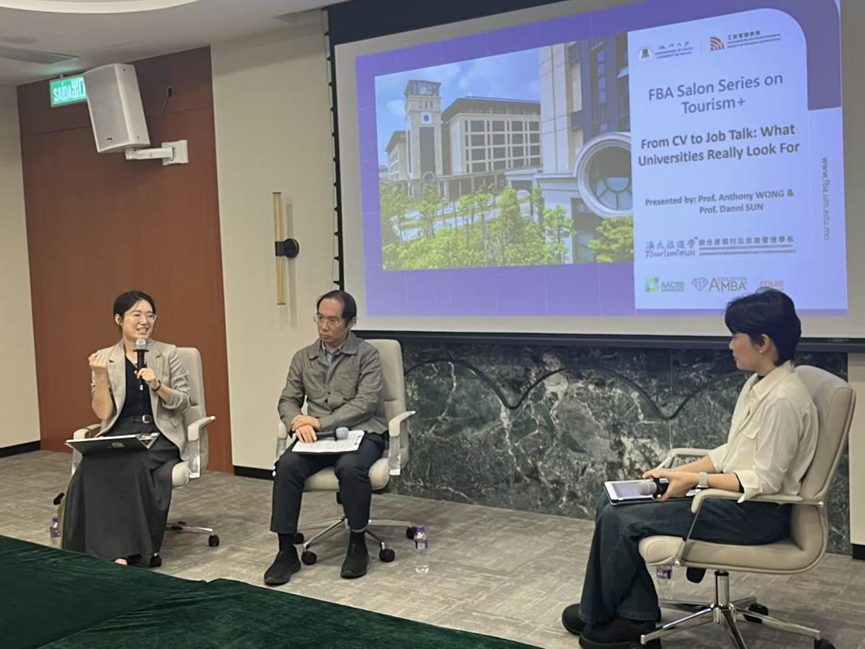
The Department of Integrated Resort and Tourism Management at University of Macau, recently successfully held an academic seminar. Professor Anthony WONG and Research Assistant Professor Danni SUN were invited as keynote speakers, delivering a talk on the theme “From CV to Job Talk: What Universities Really Look For.” They provided attending faculty and students with an in-depth analysis of the unwritten rules and practical strategies within the academic job market. The seminar was hosted by Assistant Professor Feier CHEN, with lively interactions among the participants, offering an inspiring session that combined theoretical insights with practical value.
Professor Anthony WONG approached the topic from the perspective of an experienced academic employer and mentor, systematically explaining the core logic of university recruitment—”fit.” He pointed out that search committees are looking not only for outstanding researchers, but also for the “right person” who can thrive and develop within a specific academic ecosystem. This fit is reflected in the alignment of research potential with the department’s direction, a record of publications in high-quality journals, a clear and coherent academic trajectory, and positive, collaborative personal qualities. For applicants whose research focus may not exactly match the position, Professor Wong emphasized that the key lies in systematically demonstrating, during the interview, a profound understanding of the target field and a clear blueprint for future contributions. He redefined the job-seeking process as a rational two-way selection, reminding candidates to proactively assess whether an institution’s development path aligns with their own career expectations.
Research Assistant Professor Danni SUN, drawing on her recent successful job-seeking experience, supplemented the discussion with details that are “crucial yet easily overlooked.” She noted that within the specific context of Chinese academia, the continuity of educational background and institutional reputation still carry considerable weight. She also stressed that a CV should not be a mere list of items but rather a narrative of one’s research trajectory. She suggested organizing achievements thematically, allowing the committee to quickly grasp the candidate’s academic path and potential for sustained, in-depth research. Regarding the job talk, she proposed a key mindset shift: from being a “student defending a thesis” to “presenting oneself as a future colleague.” Candidates should anticipate the core questions committees care about—how past, present, and future research form a coherent and impactful whole.
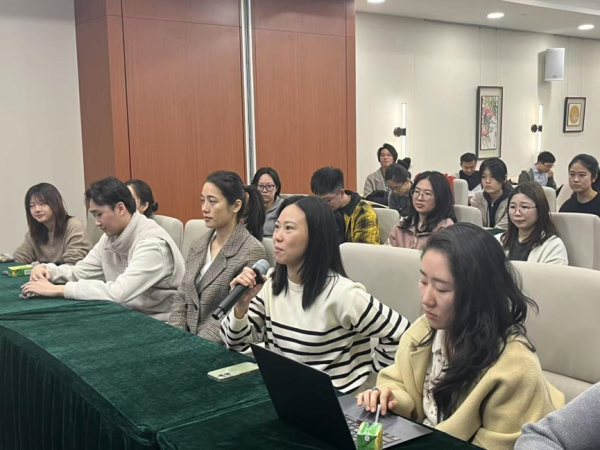
During the interactive session, attending faculty and students engaged in in-depth discussions with the speakers on various practical issues. When asked how to make one’s CV stand out among numerous applicants, both speakers agreed that specificity and focus are far more effective than being overly general. One must closely align with the job description, highlighting the most relevant experiences and skills. Another question concerned how to adjust a research proposal for a teaching-focused university. Professor Wong suggested that while demonstrating research rigor, it is crucial to emphasize the potential teaching-related applications of the research and its implications for local or industry practice. Furthermore, candidates should fully exhibit their enthusiasm and ability for classroom interaction and knowledge dissemination during their presentation.
This seminar provided substantial content and unique insights, not only deconstructing the technical aspects of academic job seeking but also guiding the audience to reflect on their own academic identity and career paths. The complementary presentations from the two speakers offered doctoral students and early-career scholars a comprehensive roadmap for academic recruitment—from internal self-assessment to external presentation—empowering participants with a clearer strategic vision and the confidence to navigate the process calmly.