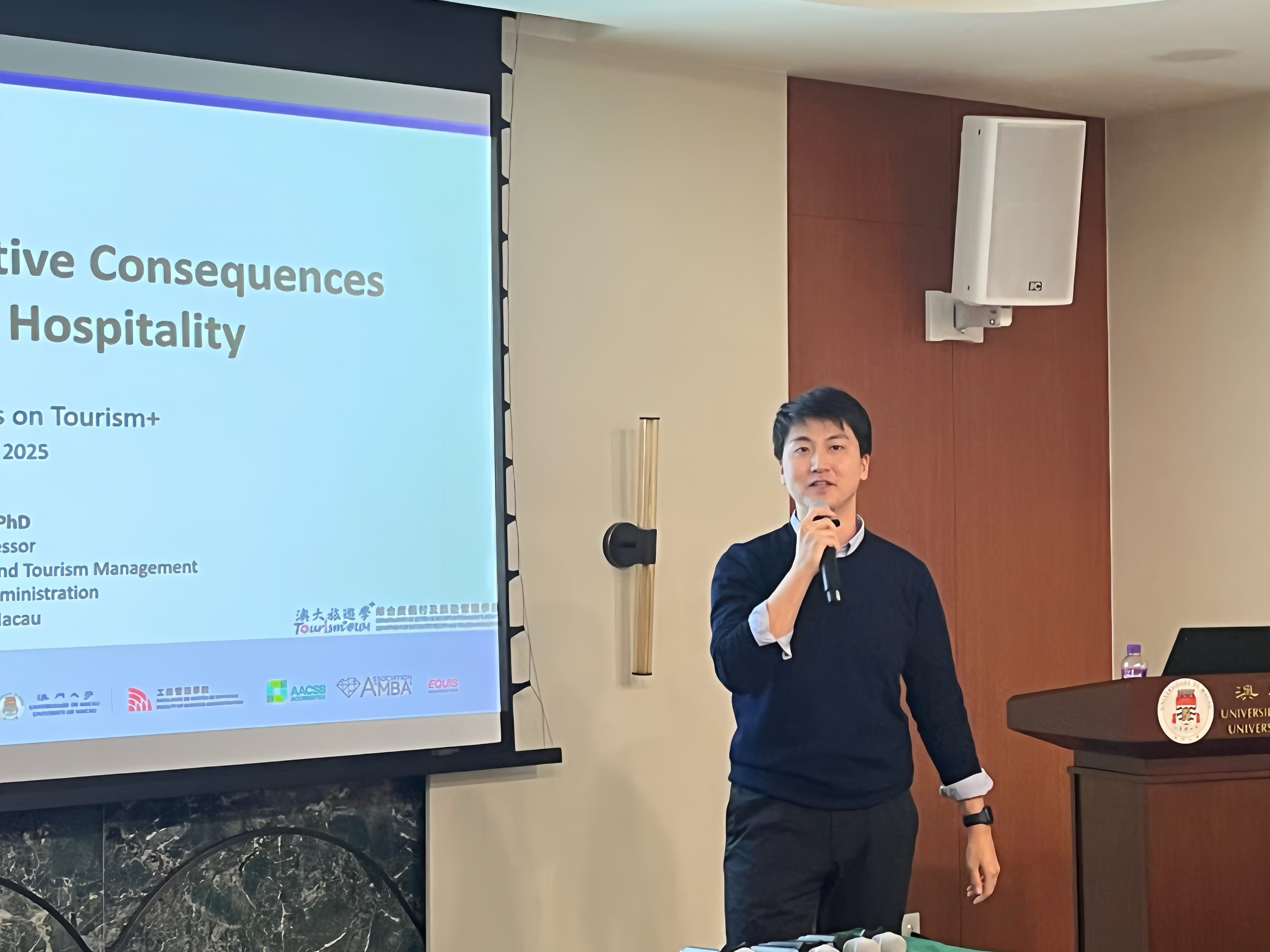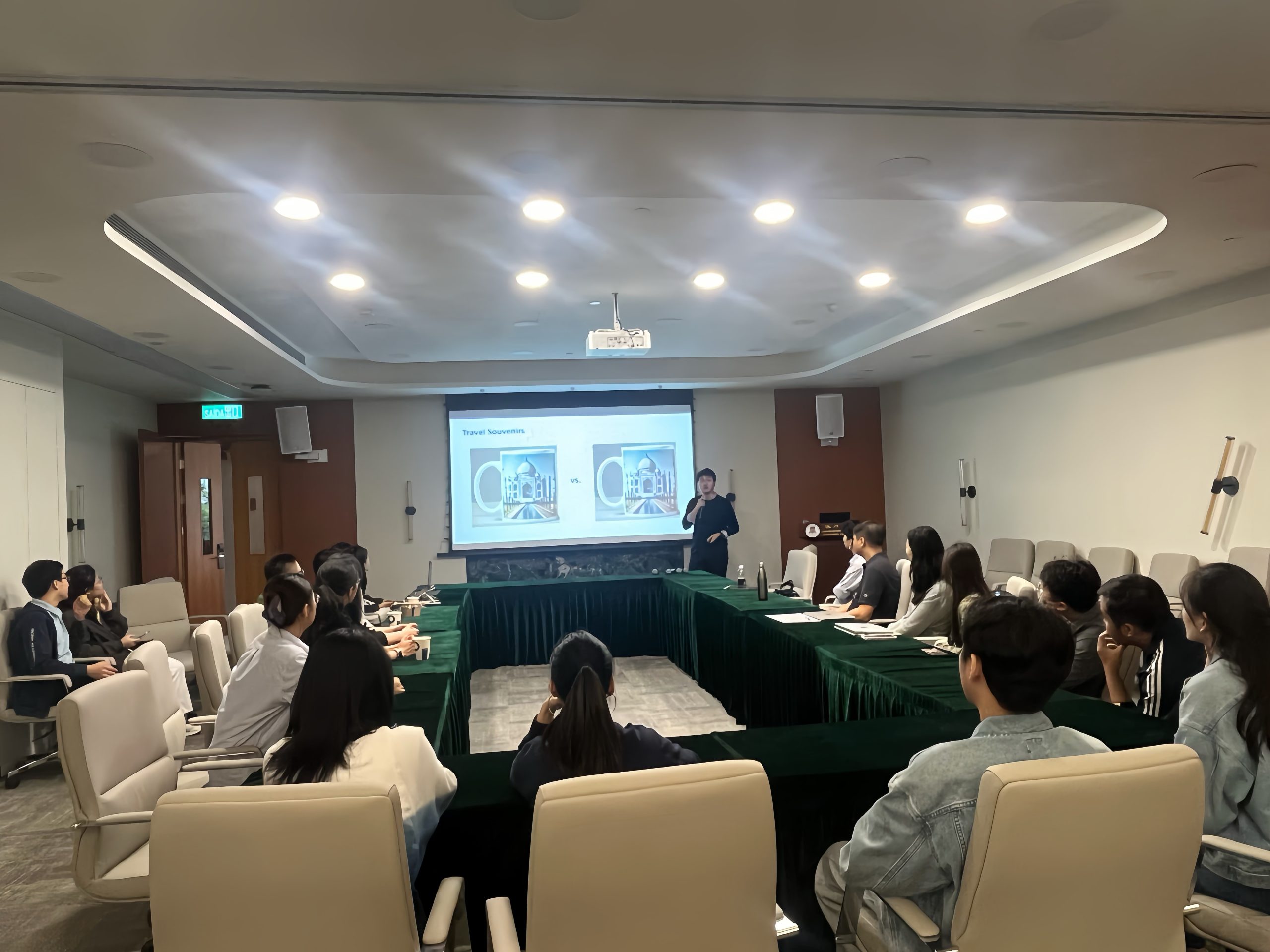
On November 11, 2025, the Integrated Resort and Tourism Management Department of the Faculty of Business Administration at the University of Macau held a “Tourism+” series salon. Assistant Professor Hyunsu KIM from the department delivered an inspiring lecture on the “Al’s Unintended Negative Consequences in Tourism and Hospitality”.
Prof. Hyunsu KIM introduced four AI-related projects from his research team, three of which have been published in SSCI Q1 journals. These studies focus on contexts such as AI-generated tourism souvenirs, AI applications in human resource management, and AI-generated travel recommendations.
Prof. Hyunsu KIM pointed out that while artificial intelligence is reshaping industry operations and creating seamless customer experiences, it also brings a series of negative consequences worthy of deep reflection. These consequences, often unintended in design, genuinely affect consumers’ perceptions, judgments, and behaviors. Drawing on frameworks such as the uncanny valley theory, theory of mind perception, and algorithm aversion, he shared empirical findings from the team’s four research projects.
Regarding the theme of AI-designed tourism souvenirs and consumer evaluations, the study found that even when souvenirs created by AI and human designers are visually identical, consumers still significantly reduce their “perceived authenticity” and purchase intention for AI-generated works. This reveals an inherent skepticism among consumers toward non-human creations regarding authenticity. Interestingly, the study further indicated that providing “time scarcity cues” or “human verification labels” can effectively mitigate such negative evaluations.
In recruitment scenarios, when job applicants are aware that their resumes are screened by AI, they perceive their “deceptive behavior as harder to detect,” leading to a significant increase in their intention and actual behavior to falsify resumes. This suggests that AI intervention may unexpectedly alter the moral decision-making context for job seekers.
Prof. Hyunsu KIM’s team also explored employees’ reactions to AI versus human HR decisions. Although AI is often perceived as more objective compared to humans, comparative studies found that employees react more negatively to the same personnel decisions (such as promotions or evaluations) when made by AI.
For the specific context of AI-generated travel recommendations, Prof. Hyunsu KIM’s team is developing and validating a domain-specific AI aversion scale. Preliminary research has identified five key influencing factors and particularly highlighted that, due to the highly experiential and cumulative nature of tourism knowledge, consumers often hold stronger reservations toward AI-provided recommendations.
During the Q&A session, the audience engaged in in-depth discussions with Prof. Hyunsu KIM on questions such as “whether the AI aversion model is universally applicable to various types of AI.”
This lecture, grounded in solid empirical research, explored the perspectives of both customers and employees, providing a comprehensive view and revealing the complex psychological mechanisms accompanying the integration of AI into the service industry. It offered profound insights to the audience.