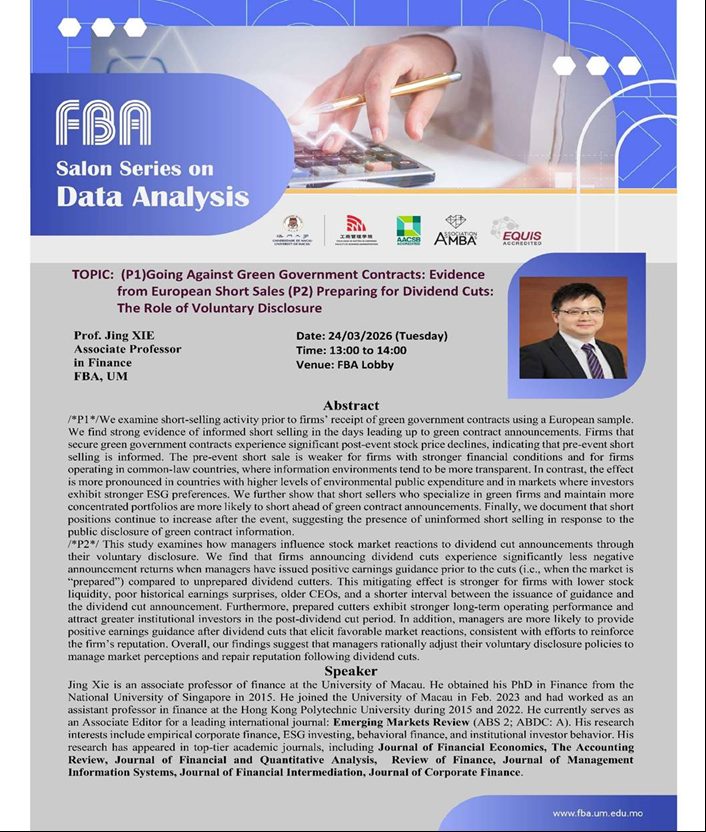
Going Against Green Government Contracts: Evidence from European Short Sales (P2) Preparing for Dividend Cuts: The Role of Voluntary Disclosure
Prof. Jing XIE
Associate Professor in Finance, FBA, UM
Date: 24/03/2026 (Tuesday)
Time: 13:00 to 14:00
Venue: FBA Lobby
Abstract
We examine short‑selling activity prior to firms’ receipt of green government contracts using a European sample. We find strong evidence of informed short selling in the days leading up to green contract announcements. Firms that secure green government contracts experience significant post‑event stock price declines, indicating that pre‑event short selling is informed. The pre-event short sale is weaker for firms with stronger financial conditions and for firms operating in common‑law countries, where information environments tend to be more transparent. In contrast, the effect is more pronounced in countries with higher levels of environmental public expenditure and in markets where investors exhibit stronger ESG preferences. We further show that short sellers who specialize in green firms and maintain more concentrated portfolios are more likely to short ahead of green contract announcements. Finally, we document that short positions continue to increase after the event, suggesting the presence of uninformed short selling in response to the public disclosure of green contract information.
/*P2*/ This study examines how managers influence stock market reactions to dividend cut announcements through their voluntary disclosure. We find that firms announcing dividend cuts experience significantly less negative announcement returns when managers have issued positive earnings guidance prior to the cuts (i.e., when the market is “prepared”) compared to unprepared dividend cutters. This mitigating effect is stronger for firms with lower stock liquidity, poor historical earnings surprises, older CEOs, and a shorter interval between the issuance of guidance and the dividend cut announcement. Furthermore, prepared cutters exhibit stronger long-term operating performance and attract greater institutional investors in the post-dividend cut period. In addition, managers are more likely to provide positive earnings guidance after dividend cuts that elicit favorable market reactions, consistent with efforts to reinforce the firm’s reputation. Overall, our findings suggest that managers rationally adjust their voluntary disclosure policies to manage market perceptions and repair reputation following dividend cuts.
Speaker
Jing Xie is an associate professor of finance at the University of Macau. He obtained his PhD in Finance from the National University of Singapore in 2015. He joined the University of Macau in Feb. 2023 and had worked as an assistant professor in finance at the Hong Kong Polytechnic University during 2015 and 2022. He currently serves as an Associate Editor for a leading international journal: Emerging Markets Review (ABS 2; ABDC: A). His research interests include empirical corporate finance, ESG investing, behavioral finance, and institutional investor behavior. His research has appeared in top-tier academic journals, including Journal of Financial Economics, The Accounting Review, Journal of Financial and Quantitative Analysis, Review of Finance, Journal of Management Information Systems, Journal of Financial Intermediation, Journal of Corporate Finance.