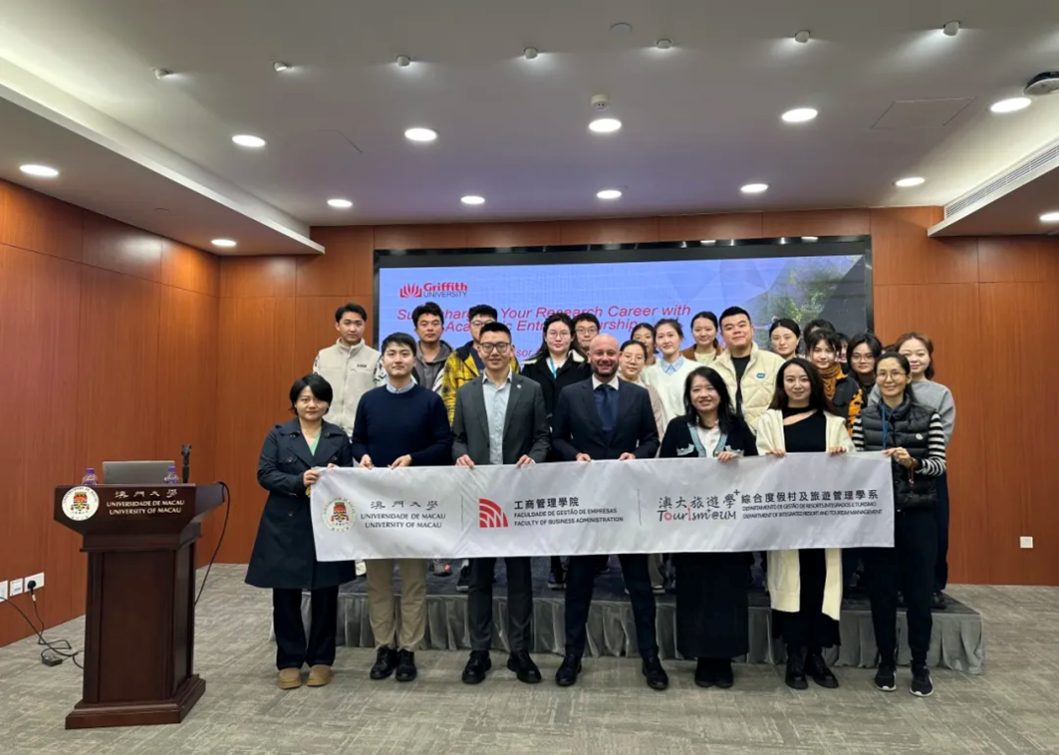
On January 9, 2026, the Department of Integrated Resort and Tourism Management hosted an academic lecture featuring Professor Brent D. Moyle from the Department of Tourism, Sport and Hotel Management at Griffith University as the keynote speaker. Under the theme “Supercharging Your Research Career with Academic Entrepreneurship,” Professor Moyle vividly shared diverse pathways for closely integrating academic research, teaching practices, and societal impact.
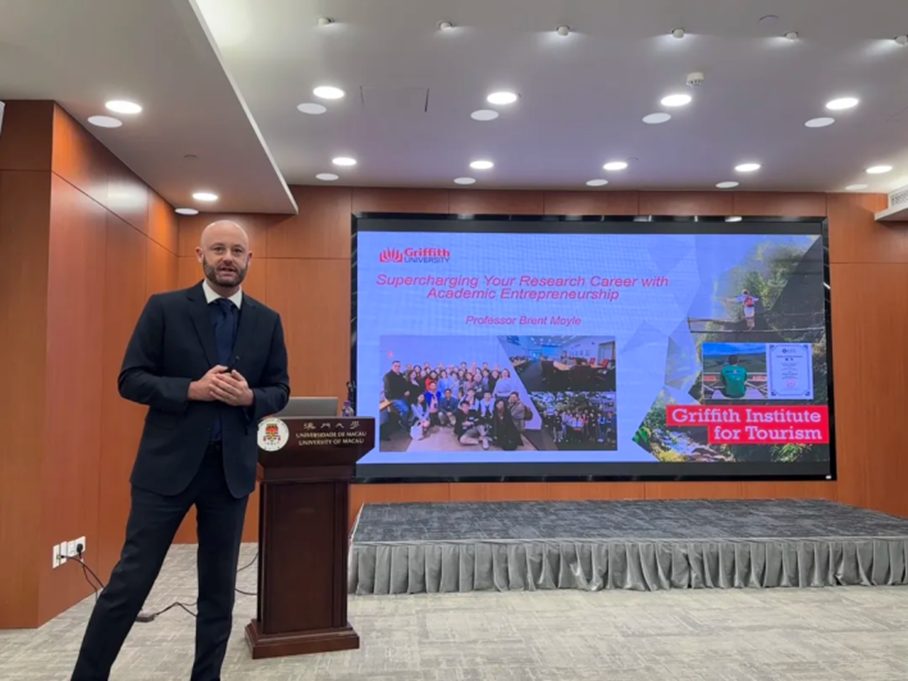
Professor Moyle first reflected on his own career journey. He mentioned that his initial decade was spent as a researcher deeply involved in various government-commissioned projects. This experience gave him a profound understanding of the complex interactions between policy formulation and local implementation. Subsequently, he transitioned into academia as a lecturer, bringing this “learning-through-practice” mindset into his teaching and research, gradually developing a unique model for university-industry collaboration.
Following this, he illustrated, through several practical case studies, how his team collaborates with government departments to promote different types of tourism destination development projects. These projects included the conservation-oriented development of canyon natural landscapes and the renovation and expansion of existing man-made attractions. He emphasized that each project requires tailoring to the local context: in natural landscape development, his team focuses on balancing ecological capacity with visitor management; while in man-made attraction upgrades, the focus is on enhancing experiences and deepening cultural narratives.
Notably, Professor Moyle organically integrated these government collaboration projects into his master’s degree curriculum. He led students to project sites for field research, allowing academic theories to be tested and applied in real-world scenarios. This not only provided robust data and analysis for policymaking but also gave students invaluable practical experience. Simultaneously, his team continuously engaged in academic refinement throughout project execution, forming a cycle of “project operation – data collection – theory building – paper publication,” thereby realizing multiple values in research, teaching, and community service.
During the interactive session, a student asked, “In the process of engaging with destination communities, have you, as a researcher, experienced empathy—not only understanding the community’s needs but also emotionally identifying with and integrating into their aspirations?” In response, Professor Moyle shared specific insights. He admitted that when he truly immersed himself in communities and listened to residents’ stories, he often developed an emotional connection that transcended mere academic observation. This empathy is not simple sympathy but a deeper identification born from understanding the community’s intrinsic motivations. Such emotional connections, he noted, often help the research team more accurately grasp the core value of a project and better balance diverse stakeholder needs when designing solutions.
The entire lecture combined theoretical vision with practical wisdom. It not only demonstrated the diverse pathways of academic entrepreneurship for the attending faculty and students but also inspired everyone to consider how research can move beyond the ivory tower to take root, grow, and create tangible impact in the real world.