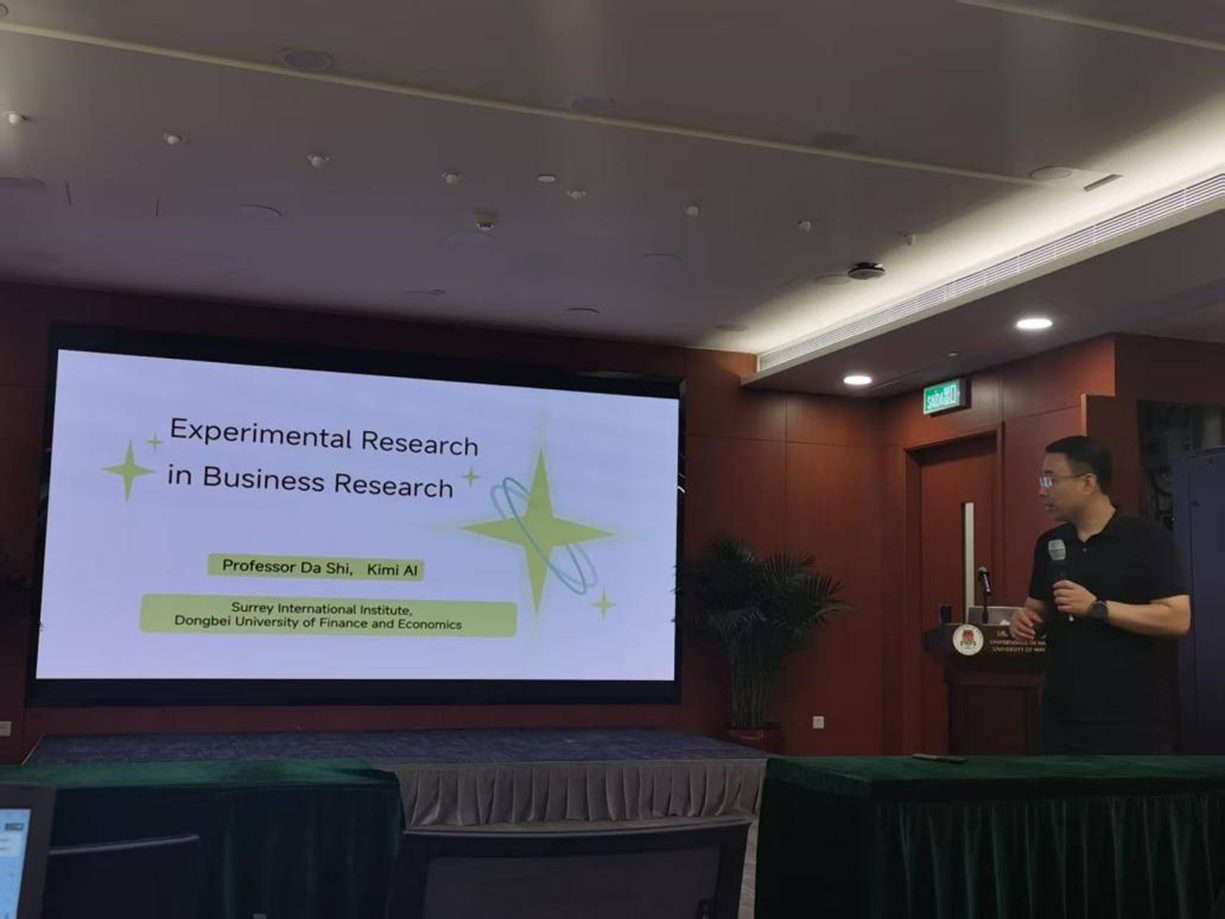
Recently, Professor Shi Da delivered an academic lecture titled “Methods and Advances in Experimental Research in Management Science” for the faculty and students of the Department of Integrated Resort and Tourism Management. Professor Shi systematically outlined the core concepts, application scenarios, and practical implementation of experimental methods, offering the audience an intellectual feast on how to scientifically explore causal relationships.
Professor Shi began from the perspective of philosophical epistemology, emphasizing that experimentation is a fundamental scientific method for understanding and interpreting the world. By actively controlling conditions and manipulating variables to test hypotheses, it aims to uncover the causal relationships underlying phenomena. He then clearly elucidated the unique advantages of experimental methods in pursuing generalizability and quantitative verification by comparing them with qualitative research methods.
Through case studies, Professor Shi further detailed the strengths and weaknesses of various research methods, such as case studies, questionnaire surveys, secondary data analysis, and experimental methods. He particularly pointed out that when the core research question involves “why” and “whether,” i.e., when establishing causal relationships between variables, experimental methods are the most rigorous and powerful tool. At the same time, he also introduced how quasi-experimental designs can compensate for the inability to achieve full randomization in real-world scenarios.
Professor Shi strongly recommended that researchers draw insights on experimental methods from other mature disciplines. For instance, the design of incentive controls and randomized experiments in economics, as well as the establishment of “double-blind” experimental protocols in the medical field to eliminate subjective bias, hold significant reference value for tourism research. Currently, the tourism academia predominantly employs “single-blind” experiments, while the “double-blind” standard represents a higher methodological pursuit.
In the segment on experimental design, Professor Shi elaborated on how to control individual differences among participants through random assignment. Additionally, he explained the benefits of econometric models used in the field of economics. Using the “Discrete Choice Experiment” as an example, he vividly demonstrated how experiments can simulate and measure tourists’ decision-making preferences among multiple attributes.
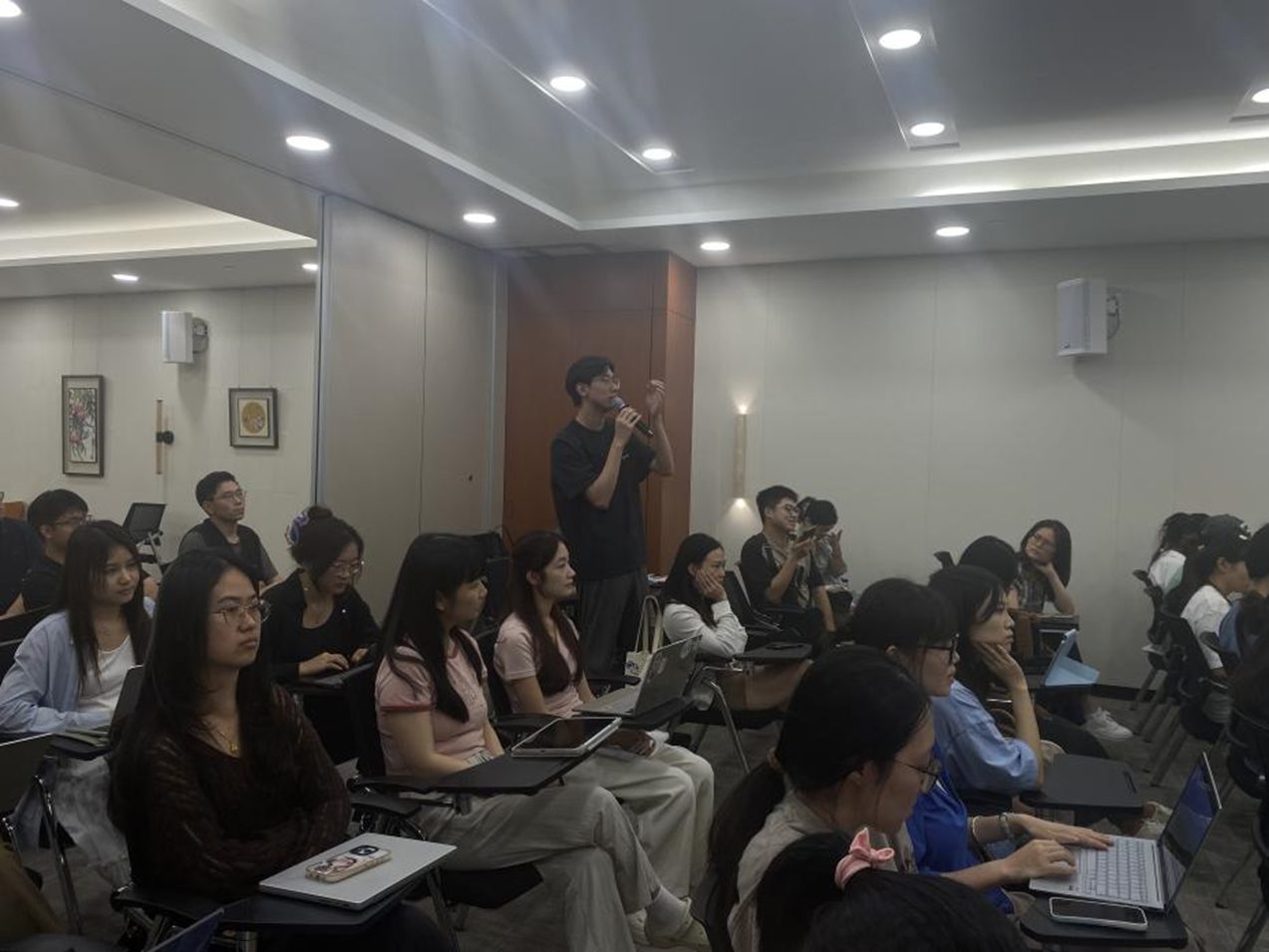
During the engaging interactive session, several faculty and students engaged in in-depth discussions with Professor Shi. One student asked, “Are there other methods that can compensate for the inherent limitations of experimental methods?” Professor Shi emphasized that research methods themselves have no absolute superiority or inferiority; their selection should be entirely determined by the ‘research question.’ While experimental methods excel in causal inference, they may have limitations in generalizability and depth, often requiring integration with other methods to collectively form a chain of evidence.
Another student raised a question on a cutting-edge topic: “Since AI is more rational than humans, can it replace humans as experimental participants in the future?” Professor Shi believed that using AI as experimental participants is an important future trend. He pointed out that AI can simulate human cognitive decision-making processes, but the design depends on the specific research objectives.
This lecture not only systematically outlined the knowledge framework of experimental methods but also stimulated profound reflections on research methodology. Professor Shi’s sharing provided valuable theoretical guidance and practical insights for researchers to design and implement more rigorous and innovative experimental studies.