Brief Introduction
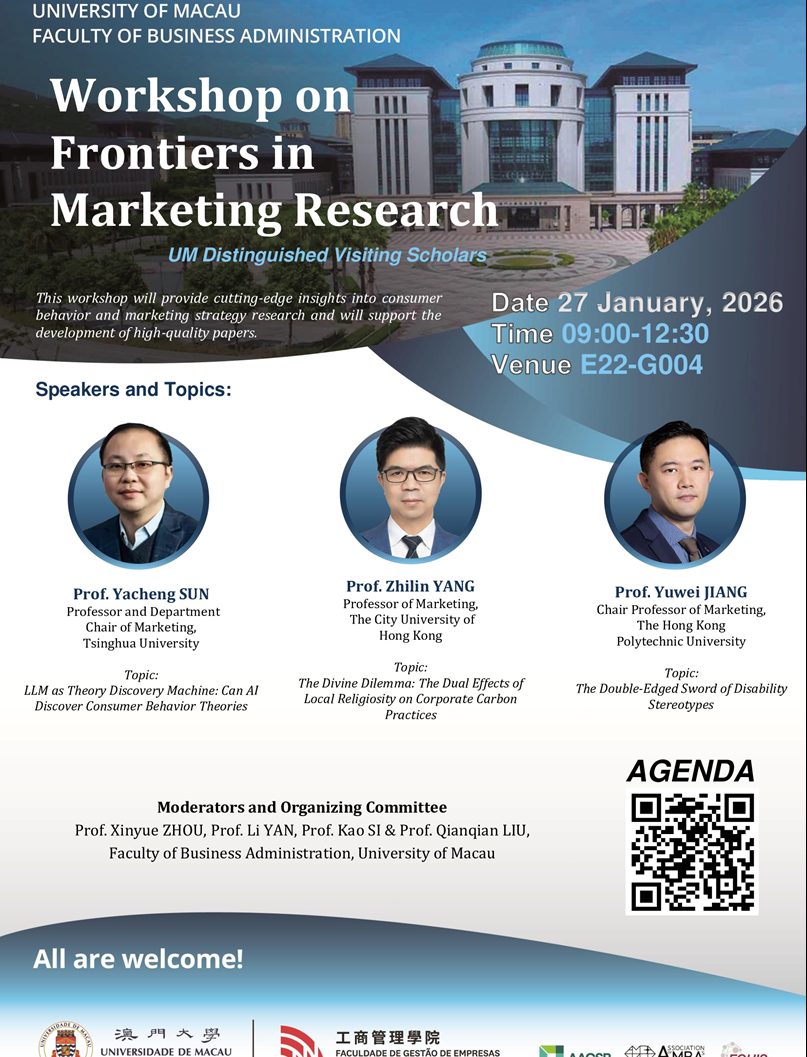
This workshop will provide cutting-edge insights into consumer behavior and marketing strategy research and will support the development of high-quality papers.
Time and Venue
Date: January 27, 2026 (Tuesday)
Venue: E22-G004
Organizing Committee
Prof. Xinyue ZHOU, Prof. Li YAN, Prof. Qianqian LIU, Prof. Kao SI
Workshop Agenda
| Time | Speaker | Topic | Moderator |
|---|---|---|---|
| 09:00-09:10 | Prof. Xinyue ZHOU, University of Macau | Welcome Speech | |
| 09:10-10:10 | Prof. Yacheng SUN*, Tsinghua University | LLM as Theory Discovery Machine: Can AI Discover Consumer Behavior Theories | Prof. Li YAN, University of Macau |
| 10:10-11:10 | Prof. Zhilin YANG*, City University of Hong Kong | The Divine Dilemma: The Dual Effects of Local Religiosity on Corporate Carbon Practices | Prof. Kao SI, University of Macau |
| 11:10-12:10 | Prof. Yuwei JIANG*, Hong Kong Polytechnic University | The Double-Edged Sword of Disability Stereotypes | Prof. Qianqian LIU, University of Macau |
| 12:10-12:30 | Discussion | Prof. Xinyue ZHOU, University of Macau | |
*UM Distinguished Visiting Scholar of UM Talent Programme
Speakers and Talks Information
Prof. Yacheng SUN

Yacheng Sun is Professor and Department Chair of Marketing at the School of Economics and Management, Tsinghua University. His research focuses on big data marketing, platform marketing, and customer relationship management. He has published in leading journals including PNAS, Marketing Science, Operations Research, Management Science, Journal of Consumer Research, IJRM and Harvard Business Review. He is a recipient of the National Science Fund for Distinguished Young Scholars and a Young Yangtze River Scholar.
Topic: LLM as Theory Discovery Machine: Can AI Discover Consumer Behavior Theories?
Abstract: Can large language models (LLMs) contribute to scientific theory generation, or is this uniquely human? This study investigates whether LLMs can discover consumer behavior theories from large-scale online review data, using established theories as benchmarks. We propose a dual-track comparison framework. The Human Theory Track derives hypotheses grounded in classical consumer satisfaction theories and uses LLM to extract theory-based variables from text. The LLM Discovery Track prompts LLM to generate hypotheses freely without theoretical priors. We systematically compare their respective and combined predictive validity through a series of model comparisons. To address concerns that LLM may merely retrieve pretrained knowledge rather than discover from data, we implement validation procedures to examine data-grounded reasoning capability. Preliminary results suggest complementary value: classical theories remain predictively valid, while LLM-discovered factors provide incremental explanatory power. The combined approach outperforms either alone, supporting the view that LLM augments rather than replaces human theorizing. This study offers the first systematic test of LLM theory discovery with theoretical benchmarks, with implications for AI-assisted research methodology.
Prof. Zhilin YANG

Zhilin Yang is a Professor of Marketing at City University of Hong Kong whose research examines marketing channel management, with a focus on institutional distance, technology, and sustainability. He has published over 130 articles in leading journals such as the Journal of Marketing, Journal of Marketing Research, MIS Quarterly, Organization Science, and the Journal of International Business Studies. His work is widely cited, and since 2022 he has been recognized among Stanford University’s top 2% most highly cited scientists. He has received the Emerald Citations of Excellence and the University Research Excellence Award at City University of Hong Kong. He serves as Editor-in-Chief of the Journal of Business-to-Business Marketing and is a founding editor of the Asian Journal of Business Research. He also founded the Annual Chinese Marketing International Conference in 2013 and the Chinese Scholar Marketing Association.
Topic: The Divine Dilemma: The Dual Effects of Local Religiosity on Corporate Carbon Practices
Abstract: Organizational behavior is shaped by corporate culture, which itself is influenced by the local institutional environment in which the firms operate. This study unravels the divine dilemma by investigating how local religiosity simultaneously drives and impedes corporate carbon practices through competing corporate cultural pathways within corporations. Drawing on social norm theory, we analyze an 11-year panel dataset of S&P 500 firms and uncover a paradox: local religiosity enhances carbon disclosure transparency by strengthening integrity-oriented corporate culture, simultaneously increasing carbon emission intensity by limiting innovation-oriented culture. We further identify CEO education as a critical contingency factor that reconciles the competing corporate cultural forces, finding that CEO’s advanced education degrees amplify religiosity’s positive effects on corporate integrity culture while mitigating its negative impact on corporate innovation culture. Our research demonstrates the complex influence of the institutional environment on organizational behavior through shaping corporate cultural pathways. Moreover, it highlights the critical role of CEOs in helping firms balance the competing demands for ethical accountability and innovation in sustainability practices.
Prof. Yuwei JIANG
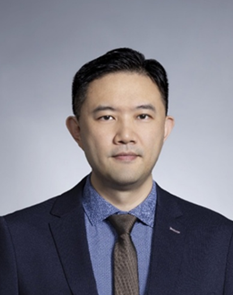
Yuwei Jiang is Chair Professor of Marketing at The Hong Kong Polytechnic University and a recipient of the NSFC Distinguished Young Scholar grant. A leading scholar in consumer psychology, his research examines how social influence, self-concept, and visual marketing shape consumer judgments and decision-making. He consistently ranks among the world’s 50 most productive marketing scholars, with work appearing in top journals such as the Journal of Consumer Research, Journal of Marketing Research, Journal of Marketing, MIS Quarterly, Strategic Management Journal, and the Journal of Personality and Social Psychology. Professor Jiang currently serves as Associate Editor for the Journal of Marketing, the Journal of Consumer Psychology, and the International Journal of Research in Marketing. His honors include the NSFC Distinguished Young Scholar (2024), Marketing Science Institute (MSI) Scholar (2020), MSI Young Scholar (2015), and AMA-Sheth Doctoral Consortium Fellow (2008). He holds a BA in Economics from the University of International Relations in China and both an MSc in Economics and a PhD in Marketing from the Hong Kong University of Science and Technology (HKUST).
Topic: The Double-Edged Sword of Disability Stereotypes
Abstract: Disability status triggers powerful, yet context-dependent, stereotypes that profoundly shape outcomes across diverse social domains. This talk synthesizes two distinct research projects to reveal how similar underlying psychological mechanisms drive divergent real-world consequences in influencer marketing and employment, challenging simplistic views of disability representation. The first project shows that content from disabled influencers consistently generates higher consumer engagement and purchase intent than content from nondisabled peers. This advantage stems from heightened perceptions of content authenticity and influencer autonomy. The second project demonstrates that disabled job candidates face significant discrimination in roles demanding high creativity. This bias is driven by a pervasive stereotype linking disability to heightened self-control, which employers erroneously equate with diminished creative capacity.